
AiM—The Central Foundation for AI in TYPO3
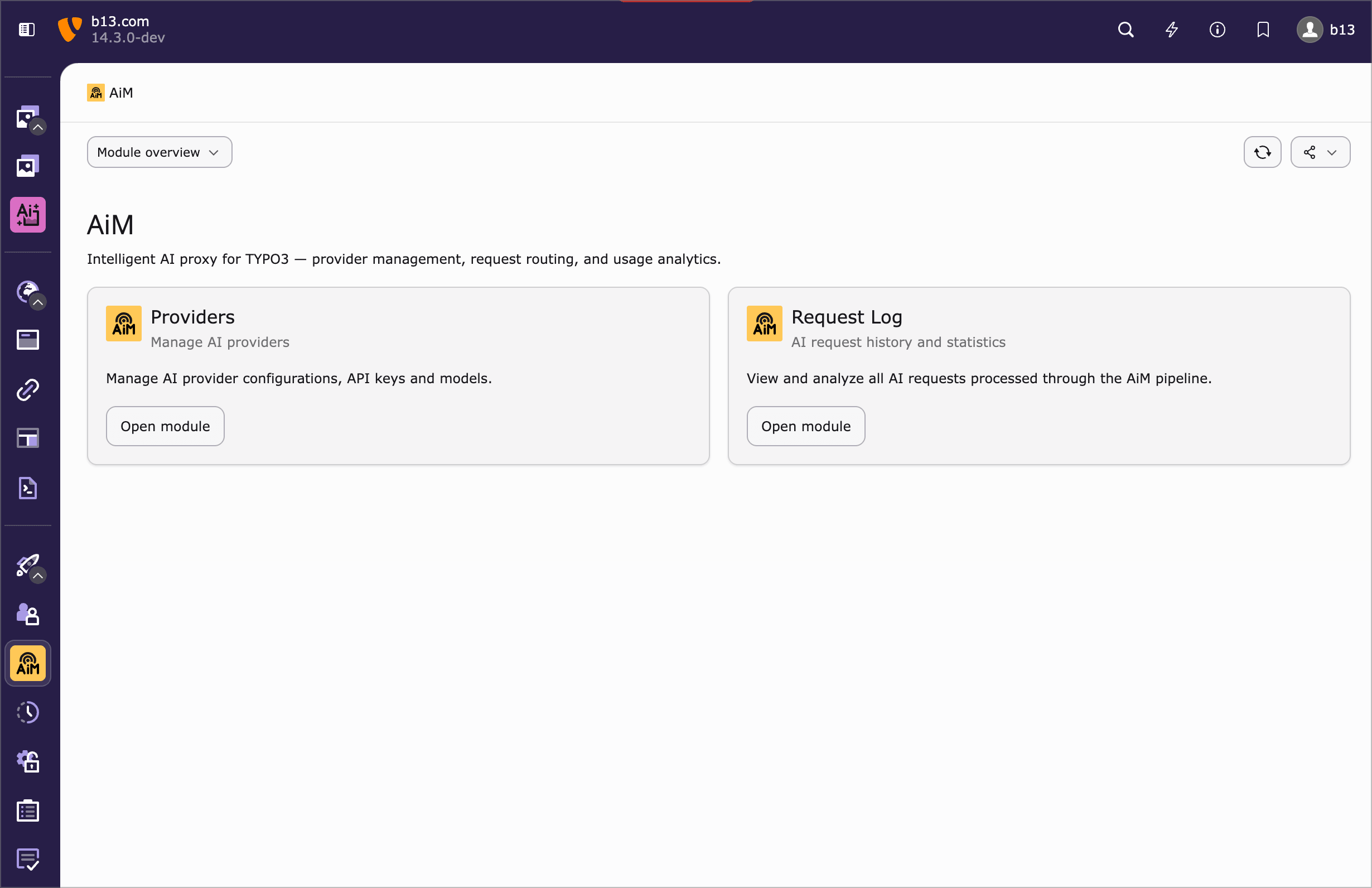
The AI Management Extension brings AI features into your TYPO3 project in a structured way. Instead of connecting every single extension directly to an AI provider, AiM bundles everything in one central place: from connecting different providers to transparency, control, and cost visibility.
This creates a clear framework for using AI productively in TYPO3—flexible, traceable, and without unnecessary dependency on just one provider.
The Right Answer to a Gap in the Core
AiM is not just another AI extension. It creates a shared foundation for AI in TYPO3 exactly where the core currently does not provide a central solution.
That is why AiM makes sense as a foundation: it structures integrations, standardizes processes, and makes AI features consistently usable for other extensions in the first place.
This means AI in TYPO3 is no longer treated as an isolated feature, but as a manageable capability across the entire system.

The Benefits at a Glance

Centralized management: AiM manages AI integrations in one place. API credentials, models, and configurations are not scattered across many different extensions but are bundled in a clean and structured way.

Easy for extension authors: Your extension simply says what it needs, such as an alt text, a translation, or a summary. AiM takes care of API keys, providers, models, costs, and logging, so you can focus on what your extension is actually for.

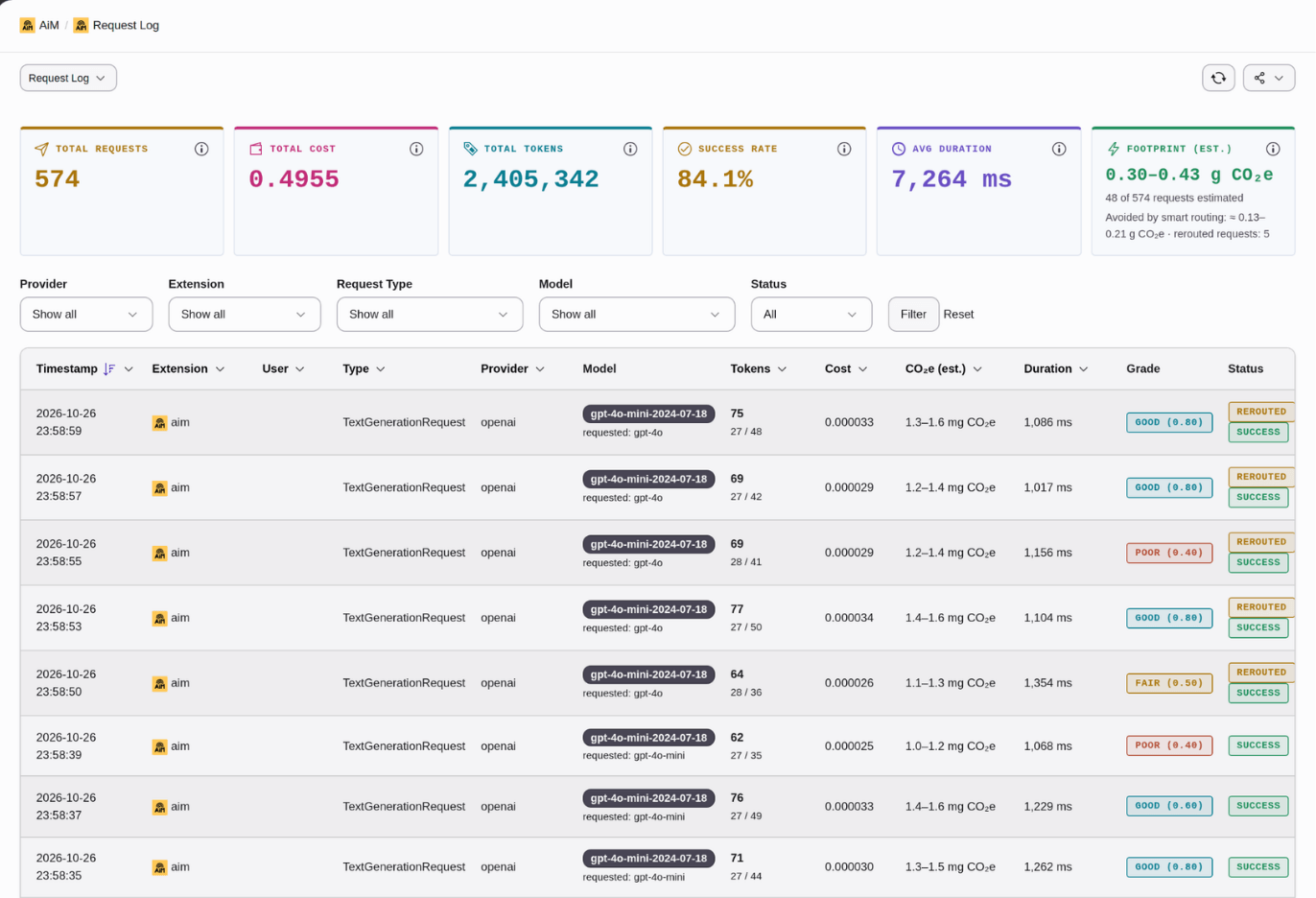
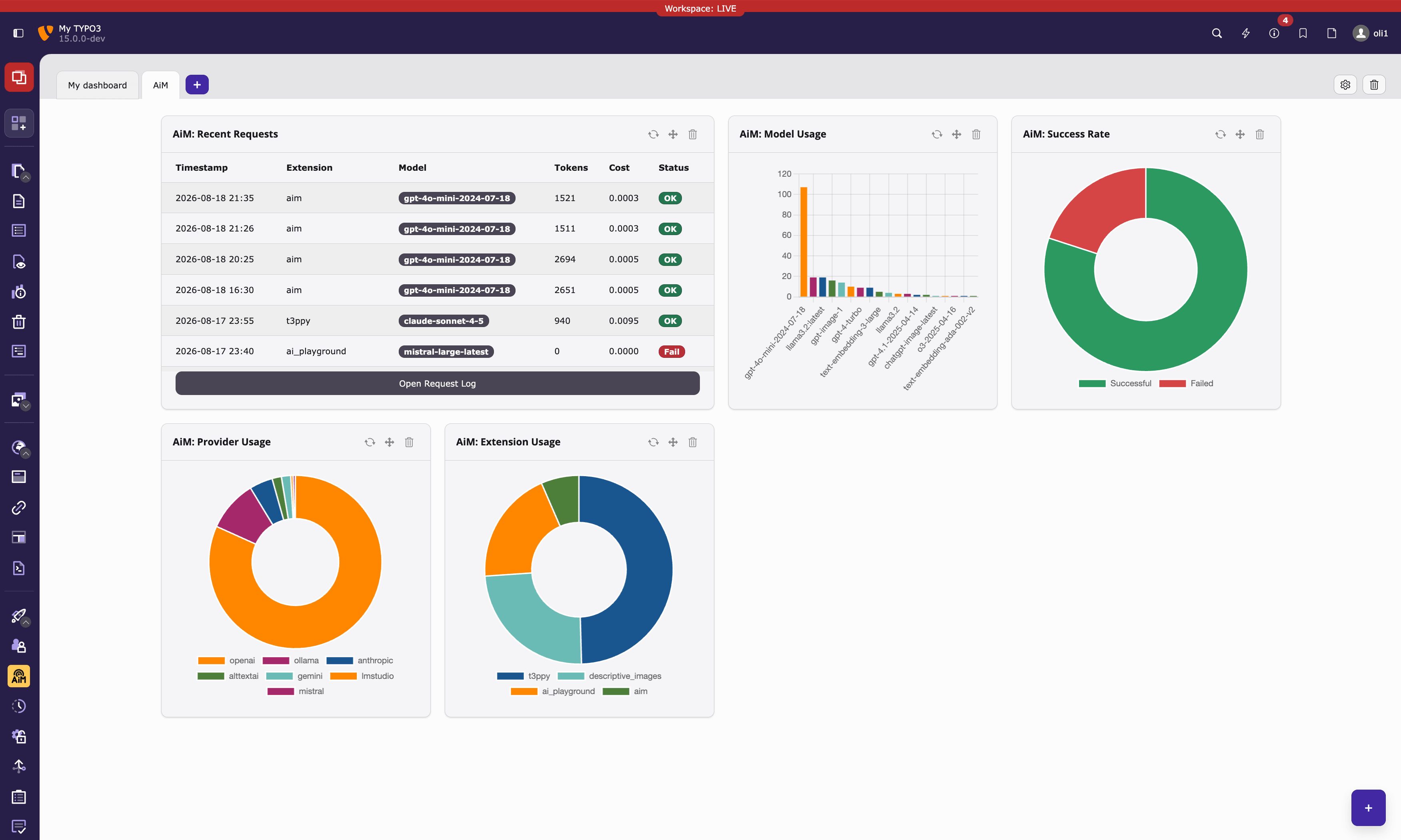
Greater transparency: Every AI request can be traced: who triggered it, what it was used for, which model was used, and what costs were incurred. This creates confidence for operations, controlling, and governance.

More freedom: AiM is not tied to a single provider. Different providers can be connected and changed when needed. This preserves both technical and strategic flexibility. Works with OpenAI, Anthropic, Google Gemini, Mistral, Ollama, and more through Symfony AI, including self-hosted gateways. Credentials are stored encrypted.

More control: Budgets, access rights, and privacy requirements can be managed in a targeted way. This makes AiM suitable not only for experimentation, but for professional use in organizations. Budgets and rate limits per user (rate limiting is on by default), privacy levels per provider (standard, reduced, or no logging), and protection against unwanted rerouting.

Protection for sensitive data: AiM includes comprehensive permission and privacy controls to protect sensitive data. With group-based provider restrictions, rerouting protection, and no-logging options, confidential information can stay within the right boundaries.

Smart routing for lower costs and more sustainable AI usage: AiM intelligently routes requests to the most suitable and cost-effective model. This helps reduce unnecessary AI spend and uses resources more efficiently by avoiding oversized models for simple tasks.

Quality in view: If you want, a second AI model grades every answer, so you can see which models deliver good results. Smart routing uses these grades and stops sending requests to models whose answers get worse.

Built to fail over: If a provider fails, AiM passes the request to the next provider in your fallback chain, so editors can keep working.

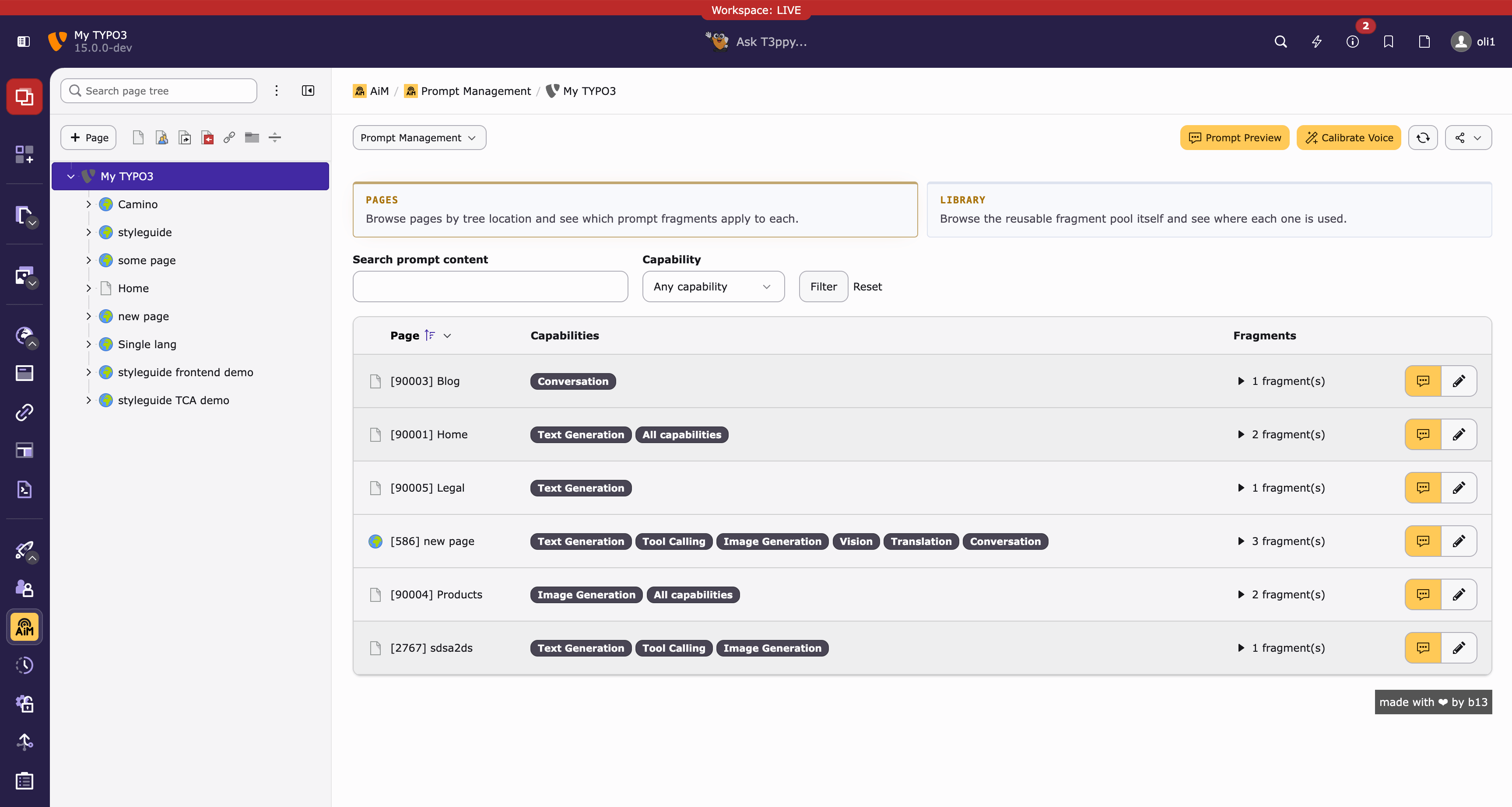
Tone of voice: System prompts and tone of voice are inherited through the page tree. AiM can derive a tone-of-voice suggestion from your real page content, which only becomes active once someone approves it.

What Is Possible Thanks to AiM?
AiM provides the foundation for a wide range of AI-supported features in TYPO3. These include, for example, automatic image descriptions, support for content creation and revision, translations, semantic search, and interactive assistants in the backend or frontend.
The strength of AiM does not lie in one single feature, but in the fact that very different AI use cases can be organized through the same infrastructure. This allows AI in TYPO3 to grow in a controlled way with your requirements, instead of spreading into many disconnected individual solutions.

For editorial teams
AiM brings AI closer to day-to-day editorial work: describing images, summarizing texts, translating content, or preparing first drafts. It reduces repetitive work while leaving quality, tone, and final decisions firmly in editorial hands.

For companies and organizations
Using AI in an organization requires more than just technical integration. AiM provides a framework for governance, privacy, cost control, and access management—turning AI in TYPO3 into a manageable part of the platform.

For developers
One call instead of a separate integration for each provider: use vision(), text(), translate(), embed(), or generateImage(), and AiM takes care of provider, credentials, model, and logging. Structured output, tool calling, and streaming are included.

Typical Use Cases
AiM is useful wherever AI should be used in TYPO3 in a structured and scalable way. For example:
- for automatic image descriptions and alt texts
- for translations and language variations
- for drafts, summaries, and metadata
- for semantic search and content relationships
- for chat or assistant features in TYPO3
- for workflows in which AI should interact with TYPO3 data
- for generating images, including in the style of a reference image
- …
See the CO₂ Footprint of Every Request
AiM estimates the electricity and CO₂e behind each AI request and shows it next to the cost in the request log. Each estimate shows what it’s based on, uses a range wherever the model size isn’t published, and is never filled in with zero when data is missing. Smart routing also shows how much CO₂e it avoided by sending simple requests to smaller models.

Oliver Bartsch
Development
Download AiM and Simplify AI in TYPO3
AiM runs on TYPO3 12.4, 13.4, and 14 with PHP 8.1+, and installs with composer require b13/aim. AiM is still in alpha: it works, but the API may change before version 1.0.
Feedback is welcome, ideally as an issue on GitHub.
Powered by AiM

