
Documentation
TYPO3 Module “Single-Sign-On”
Version 2.0.3 (04 Nov 2026)
Chapters of this Documentation
TYPO3 is the service provider. It never sees a password: it sends an authentication request to the identity provider, and the identity provider sends back a signed assertion naming the user. Everything below is that exchange, plus what TYPO3 does with the result.
The Pieces
| Class | Role |
|---|---|
SsoAuthentication | The authentication service. Validates the assertion, resolves the TYPO3 user, decides whether the login is accepted. Registered at priority 80—above the username/password service at 50 |
SsoLoginProvider | The backend login screen entry, and the redirect to the identity provider |
BackendSsoReceiver | Backend middleware. Serves the metadata endpoint and turns an incoming assertion into something core's authentication recognizes |
FrontendSsoReceiver | The same for the frontend, plus the redirect to the identity provider |
FrontendRedirectToIdp | Frontend middleware running after authentication. Handles enforcement, logout, and the no-groups case |
ProvideRequestTokenProvider | Supplies the request token core expects from a login form, which an SSO login has no form to get it from |
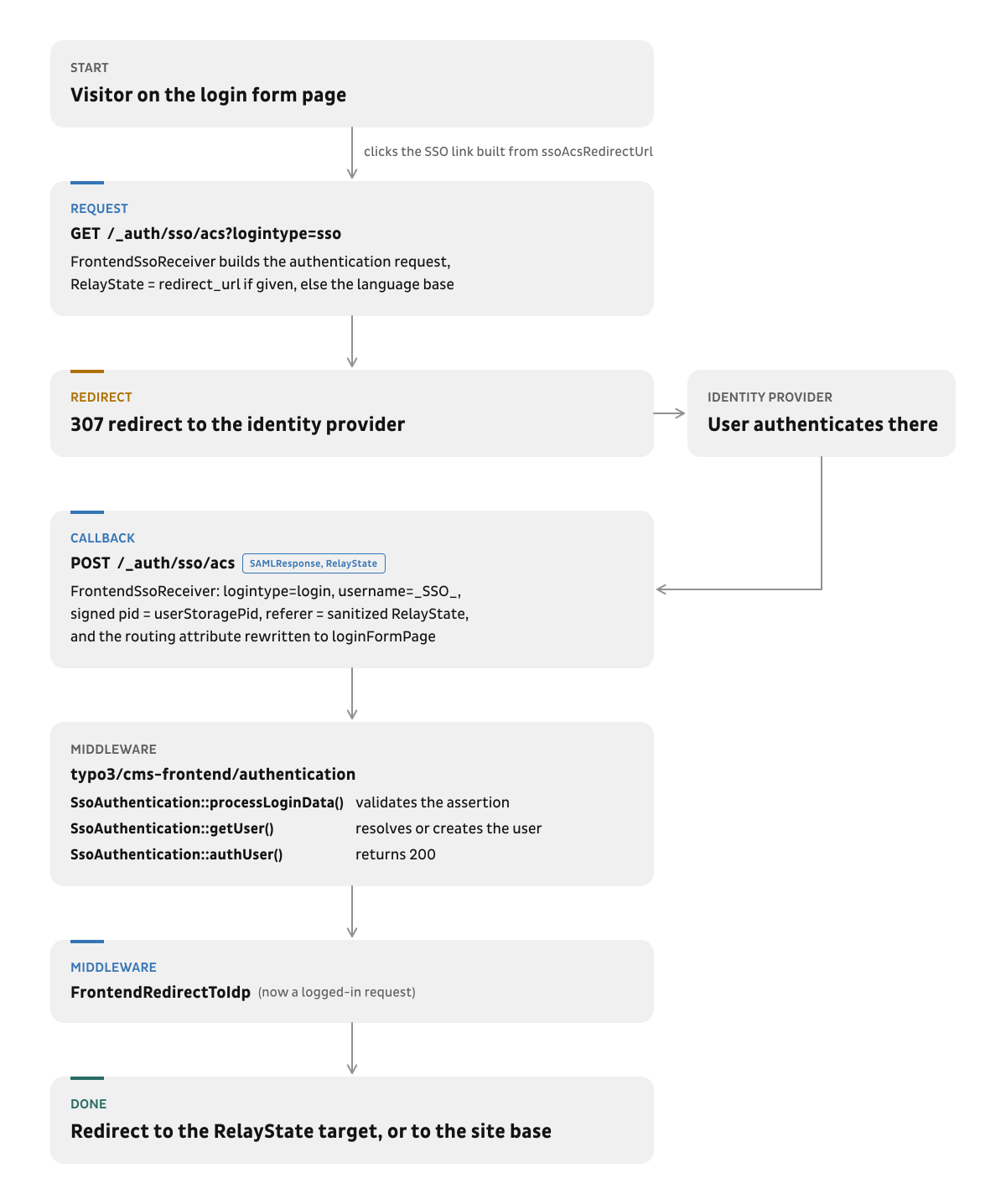
A Frontend Login
The routing rewrite in the middle is not cosmetic. The assertion arrives at the assertion consumer service path, which is not a TYPO3 page—left alone, TYPO3 would answer the request that carries the successful login with a 404. The middleware makes routing resolve loginFormPage (or the site root) instead.
The pid handed to core carries an HMAC alongside the value, which is how FrontendUserAuthentication accepts a storage folder restriction it did not receive from a form.
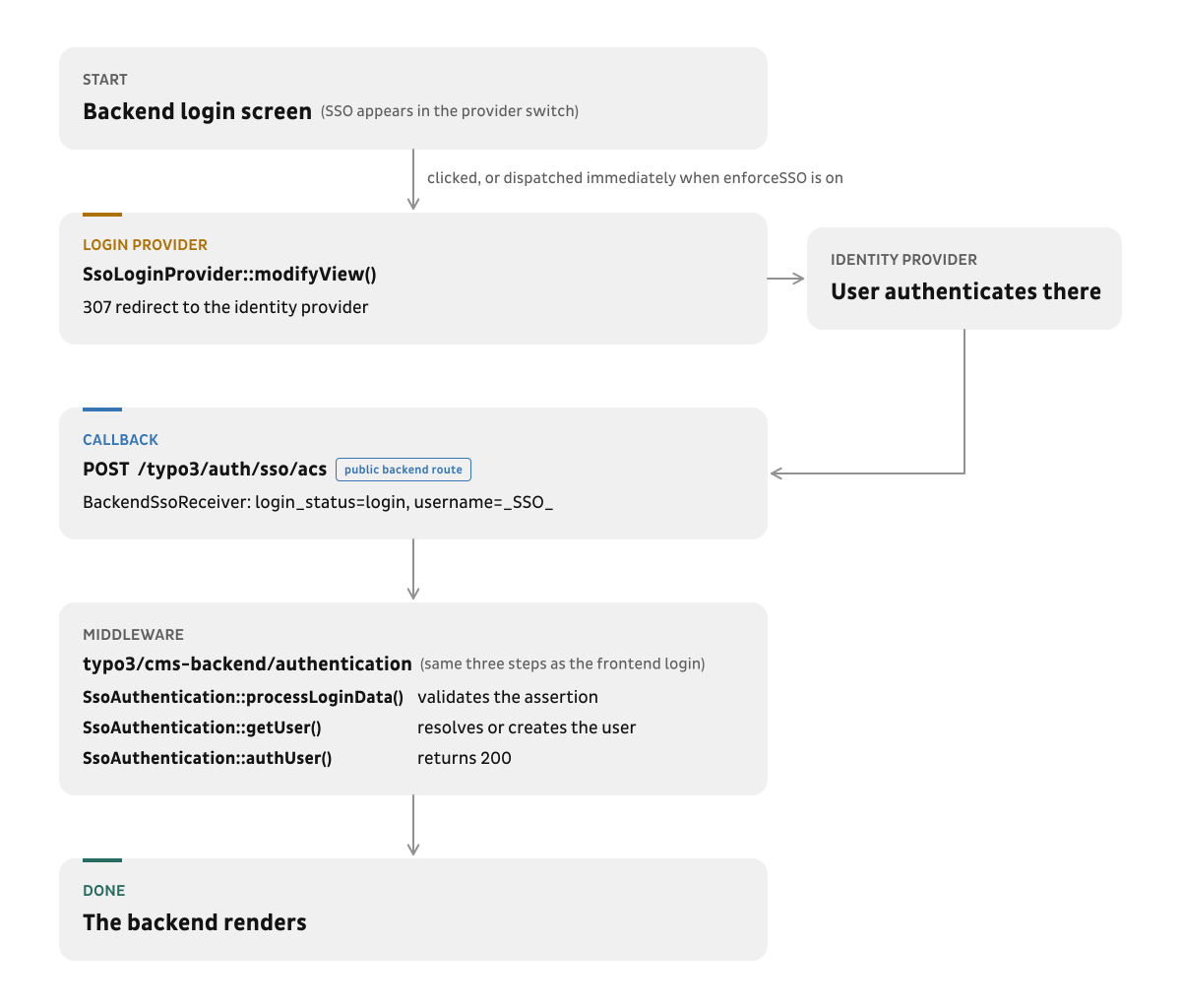
A Backend Login
The assertion consumer service is a registered backend route with access: public, so an unauthenticated POST reaches it. Its target is core's own BackendController::mainAction, which means the request that delivers the assertion is also the request that renders the backend—no intermediate redirect, and no chance of losing the POST body on the way.
The metadata endpoint needs no route. BackendSsoReceiver runs before backend routing and answers it directly.
What Happens to the User Record
On every successful login, whether the user was found or just created:
- The mapped claims are written to the user record
tx_sso_objectidentifieris set from the object identifier claim, falling back to the name identifier when the identity provider sends nonetx_sso_tenantidis set when a tenant claim is presenttx_sso_sessionindexis set from the assertion’s session index, which is what a later single logout request needs- Group membership is reconciled when a claim maps to
usergroup
The details, including which groups survive, are in User Federation. A listener can change what is written, see Events.
?logintype=sso
Starts a frontend login. It is only acted on at the assertion consumer service URL, with a GET—/_auth/sso/acs?logintype=sso by default. Anywhere else the parameter is ignored.
This is the URL ModifyFrontendLoginView hands your template as ssoAcsRedirectUrl, ready-made. It is also where the enforced redirect sends an anonymous visitor. See Frontend Login.
Single Logout
?logintype=slo is the frontend logout, and it covers three different situations. All of them are handled in FrontendRedirectToIdp, which runs after authentication and therefore knows whether anybody is logged in.
Service-provider-initiated—the visitor logs out of TYPO3. A logged-in request carrying ?logintype=slo produces a logout request built from the user's tx_sso_sessionindex and their username as the name identifier, and the visitor is redirected to the identity provider to end the session there too. The TYPO3 session is still alive at this point.
Identity-provider-initiated—or the response to the above. A request carrying SAMLResponse or SAMLRequest in the query string while logged in is processed as single logout: the TYPO3 frontend session is ended, and the visitor is redirected to whatever the toolkit returns, or to the site base. This is also the branch that closes out the service-provider-initiated case, because the identity provider sends its logout response back to the single logout endpoint—the site base with ?logintype=slo.
Already logged out. ?logintype=slo on the site base or the assertion consumer service URL without a session redirects to loginStatusPage.
The backend has no equivalent. The single logout URL is generated into the backend metadata, but no middleware handles it. Logging out of the backend ends the TYPO3 session and nothing else—the identity provider still considers the user signed in, so the next backend login goes through without a prompt.